

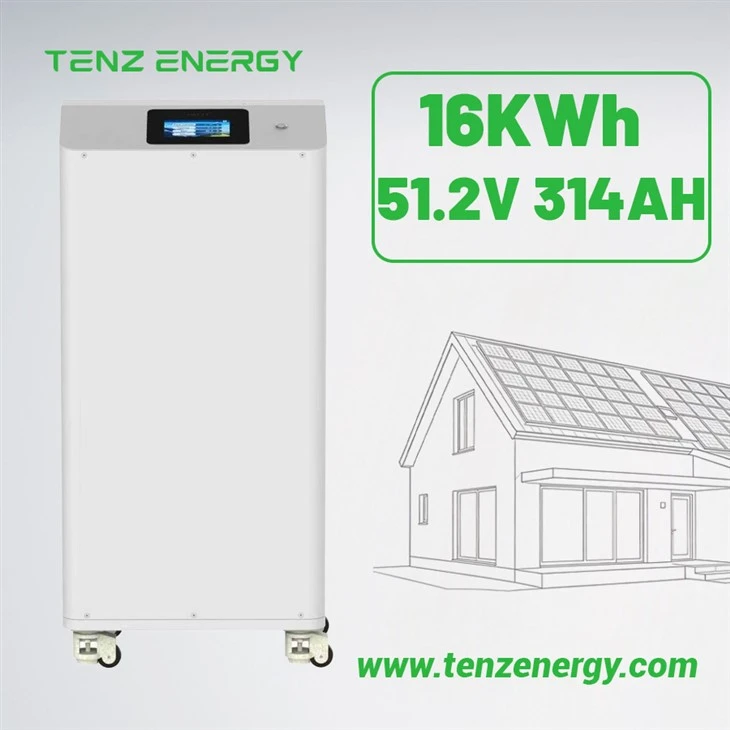


The Tenz Energy ECO-314L-(ST) is a 51.2V, 314Ah lithium-ion battery system with 16.0768kWh of nominal energy.
It is designed to be integrated into a compatible energy storage system and can serve as the battery component of residential solar battery back up systems.
For installers and distributors, this model offers a defined electrical specification for project planning, with CAN and RS485 communication interfaces and support for connecting compatible battery units in parallel. The final backup capability depends on the complete system design, including the inverter, selected loads and installation settings.

Start with the Loads You Need to Keep Running

A backup system should be selected around the equipment that matters most during an outage. Lighting, refrigeration, communications equipment and other household loads have different power demands and operating patterns. Their combined consumption determines how much stored energy may be needed.
The ECO-314L-(ST) provides 16.0768kWh nominal energy. This gives installers a clear starting point for evaluating a project, but nominal energy is not the same as guaranteed usable energy. Actual runtime depends on the usable battery capacity, inverter losses, load profile and operating conditions.
Before specifying the battery, consider three practical questions:
Which appliances must continue operating during a power interruption?
What is their combined power demand, including any starting current requirements?
How many hours of backup are required before the system can recharge?
These details help determine whether one battery is suitable or whether a larger parallel configuration should be evaluated.

Battery Monitoring for Backup Applications
The battery management system is an important part of the ECO-314L-(ST). According to its specification, the BMS monitors battery voltage and temperature, supports cell balancing and provides configurable protection functions.
The system includes four battery temperature sensors, one ambient temperature sensor and one MOS temperature sensor. It can also retain up to 500 historical fault records, providing useful information for technical inspection and troubleshooting.
For a backup installation, these functions support battery monitoring and maintenance. They do not replace the need for suitable inverter protection, correct electrical installation or a properly designed backup circuit.
Electrical Ratings for System Design
The battery's voltage and current limits should be checked against the inverter and the expected load. The ECO-314L-(ST) has a nominal voltage of 51.2V and an operating voltage range of 43.2–58.4V.
Its standard charge and discharge current is 100A at 25±2°C, while the specified maximum charge and discharge current is 200A at the same ambient temperature condition. The inverter and the rest of the system must be configured within the applicable limits.
The battery supports CAN and RS485 communication. However, matching connectors or communication interfaces alone do not establish compatibility. The specific inverter model, communication protocol and required settings should be checked before the system is approved for installation.
Technical Data
| Item | ECO-314L-(ST) Specification |
|---|---|
| Battery chemistry designation | Lithium-ion |
| Nominal voltage | 51.2V |
| Operating voltage range | 43.2–58.4V |
| Nominal capacity | 314Ah |
| Nominal energy | 16.0768kWh |
| Electrical configuration | 1P16S |
| Standard charge current | 100A at 25±2°C |
| Standard discharge current | 100A at 25±2°C |
| Maximum charge current | 200A at 25±2°C |
| Maximum discharge current | 200A at 25±2°C |
| Charging temperature range | 0°C to 40°C |
| Discharging temperature range | -20°C to 40°C |
| Specified cycle life | 8,000 cycles under stated test conditions |
| Communication interfaces | CAN and RS485 |
| Enclosure protection rating | IP20 |
| Product dimensions (L × W × H) | 890.5 × 420 × 267mm |
| Product weight | 120kg ±3kg |
| Operating altitude | 0–3,000m |
| Relative humidity | 5–75% |
| Maximum parallel connection | 16 compatible battery units |
The specified cycle life of 8,000 cycles is based on testing at 25°C, with 100A charge/discharge current and 70% depth of discharge (DOD). Results in actual installations may differ with operating conditions and usage.
Capacity Expansion for Different Backup Requirements
Not every property needs the same amount of stored energy. A system designed for essential appliances may have different capacity requirements from one intended to support a broader range of household equipment.
The ECO-314L-(ST) specification permits up to 16 compatible battery units connected in parallel. The actual system capacity and performance will depend on the approved configuration, inverter capability, cabling and current limits.
Battery units must not be connected in series. Batteries from other brands or models must not be mixed into the configuration. Any proposed expansion should be checked against the product instructions and the requirements of the complete energy storage system.
Installation Environment and Operating Conditions
The ECO-314L-(ST) has an IP20 protection rating. It should therefore be installed in a dry, ventilated area protected from rain and direct water exposure, rather than treated as a waterproof outdoor battery.
The installation surface should be level and non-flammable, with sufficient space for heat dissipation. The specification also advises against stacking units in multiple layers. The battery should be switched off when connecting its power harness, and installation should follow the approved product instructions.
For backup operation, the complete installation must include suitable power conversion equipment and an appropriate method of supplying the designated loads during an outage. Local electrical requirements and the inverter manufacturer's instructions must also be followed.
Questions Buyers Ask Before Choosing a Backup Battery

What should I check before buying a solar battery backup system?
Start with your essential loads, expected backup duration and inverter specifications. Then compare the battery's nominal energy, voltage range, current limits and communication requirements against the proposed installation. These checks are more useful than selecting a battery based on capacity alone.
Is 16.0768kWh enough to provide overnight backup?
It depends on the electricity consumption of the loads being supported and the energy available for use. The ECO-314L-(ST) has 16.0768kWh nominal energy, but the actual runtime cannot be determined from that figure alone. A load assessment and system calculation are needed.
Can this battery operate without an inverter?
The battery is a component of an energy storage system, not a standalone household AC power supply. A suitable inverter or power conversion system is required for applications that need AC electricity. The inverter must support the battery's electrical ratings and intended operating mode.
Does the battery automatically provide power when the grid fails?
Not by itself. Automatic backup operation depends on the capabilities and settings of the inverter and the design of the complete installation. Confirm that the selected equipment supports the required backup function before commissioning.
Can the battery be used with any 51.2V inverter?
No. Nominal voltage alone is not sufficient to establish compatibility. The operating voltage range, charge and discharge current limits, communication protocol and inverter configuration must all be checked.
What does the 8,000-cycle rating mean?
The specification gives a cycle-life figure of 8,000 cycles under defined conditions: 25°C, 100A charge/discharge current and 70% DOD. It should be presented together with these conditions rather than interpreted as a guaranteed result in every application.

Discuss Your Backup Power Requirements with Tenz Energy
For residential energy storage distributors, solar installers and project developers, choosing the right battery begins with the intended application and the electrical requirements of the system.
Share your inverter model, the loads you want to support, your required backup duration and your target battery capacity. The Tenz Energy team can review the technical requirements and provide relevant product information for evaluation. OEM and ODM requirements can also be discussed according to the project scope.
Hot Tags: solar battery back up systems, China solar battery back up systems manufacturers, suppliers, factory